UTM vs CTM: The Core Difference at a Glance
A Universal Testing Machine (UTM) can perform tension, compression, bending, shear, and flexural tests on a wide variety of materials, while a Compression Testing Machine (CTM) is purpose-built exclusively for compressive force testing—primarily on concrete, bricks, and construction aggregates. If you need multi-mode testing across diverse materials, a UTM is the right choice. If your work focuses solely on compressive strength of construction materials, a CTM delivers better value and precision for that specific task. Understanding the structural, mechanical, and application-level differences between these two machines helps laboratories, manufacturers, and quality control engineers make the most cost-effective and technically sound investment.
What Is a Universal Testing Machine?
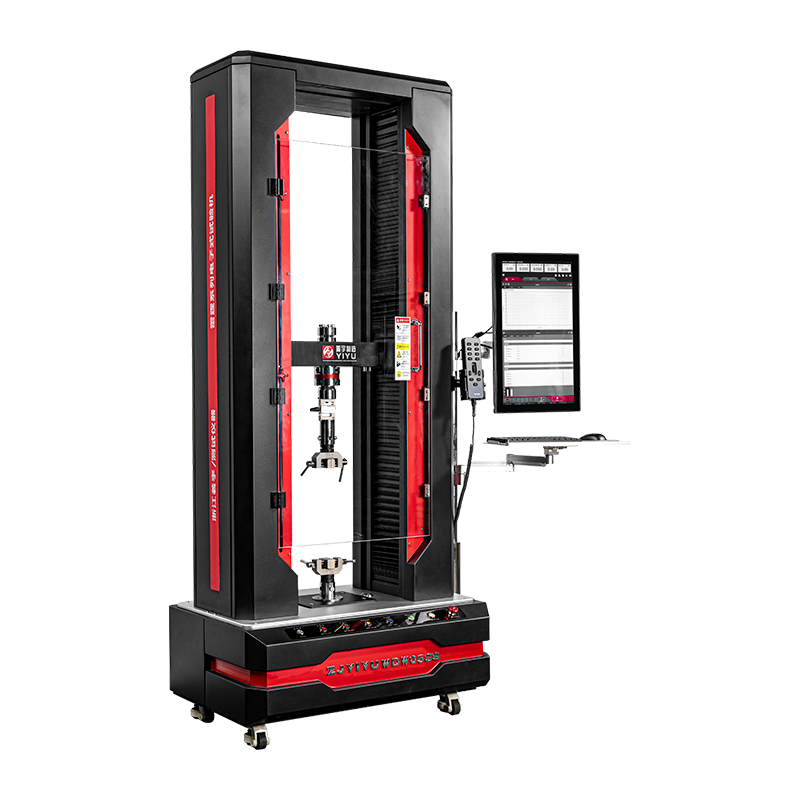
A Universal Testing Machine is a materials testing instrument designed to apply controlled forces to a specimen and measure its mechanical response. The term "universal" reflects its ability to conduct multiple test modes within a single frame, making it one of the most versatile instruments in any materials laboratory.
Core Test Modes a UTM Performs
- Tensile testing: Pulls a specimen apart to measure ultimate tensile strength, yield strength, and elongation at break.
- Compression testing: Pushes a specimen downward to measure compressive strength and deformation behavior.
- Flexural (3-point or 4-point bend) testing: Measures the bending strength and modulus of beams, boards, and flat specimens.
- Shear testing: Determines the resistance of a material to shearing forces applied parallel to its cross-section.
- Peel and adhesion testing: Measures bond strength of coatings, adhesives, laminates, and films.
UTM Capacity and Configuration
UTMs are available in a broad force range—from tabletop models with 1–10 kN capacity for testing plastics, textiles, and rubber, to floor-standing industrial frames reaching 2,000 kN (2 MN) or more for testing structural steel, composites, and automotive components. Most modern UTMs use a servo-hydraulic or electromechanical drive system, with electromechanical systems (ball screw or linear actuator driven) dominating in the 1–300 kN range for their precision and cleanliness.
Industries and Standards That Rely on UTMs
- Metals and alloys (ASTM E8, ISO 6892-1 for tensile testing)
- Plastics and polymers (ASTM D638, ISO 527)
- Rubber and elastomers (ASTM D412, ISO 37)
- Textiles and geotextiles (ASTM D5034, ISO 13934)
- Aerospace composites (ASTM D3039, D3410)
- Medical devices and biomaterials (ISO 10993)
What Is a Compression Testing Machine?
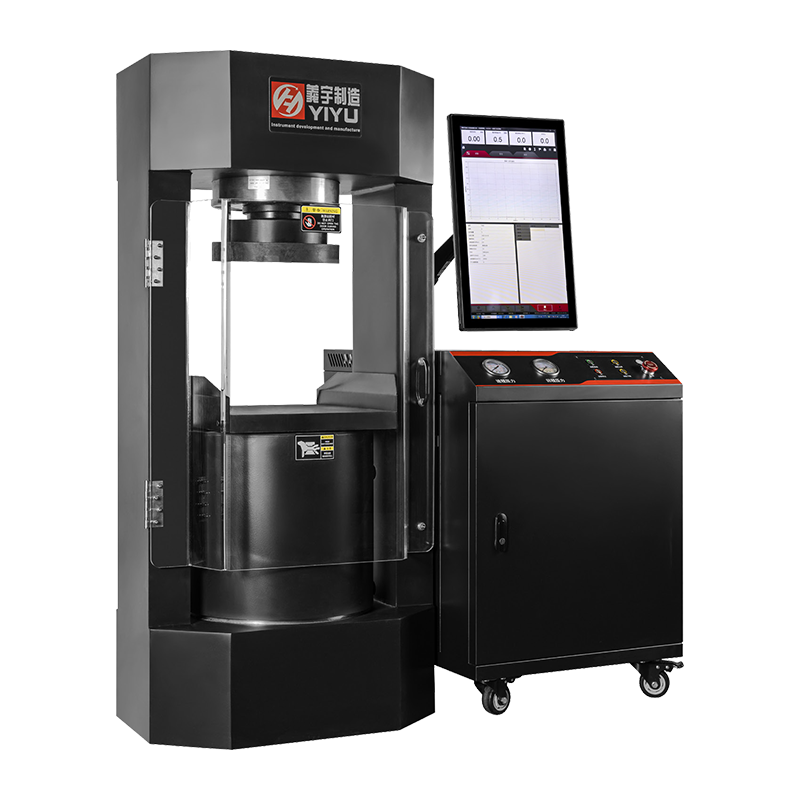
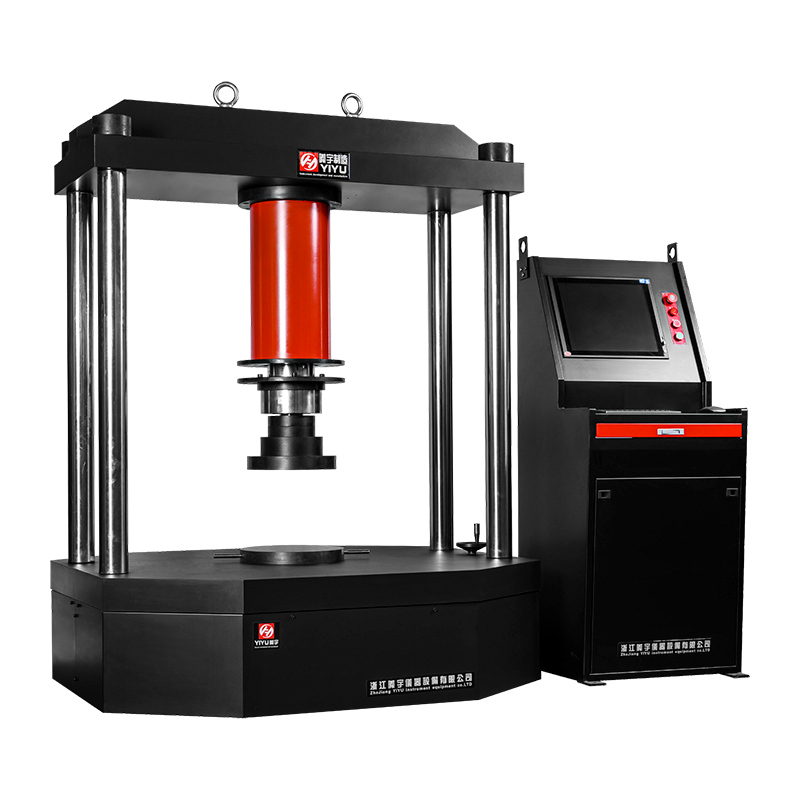
A Compression Testing Machine is a specialized hydraulic or electromechanical press designed specifically to apply high compressive loads to rigid specimens—most commonly concrete cubes, cylinders, bricks, blocks, and pavers. Unlike a UTM, a CTM has no crosshead reversal for tensile loading and no extensometer attachment for measuring elongation. Its design is optimized for one purpose: applying a controlled, centered compressive force until specimen failure.
Mechanical Design of a CTM
Most CTMs consist of a rigid lower platen fixed to a heavy steel base, an upper platen that descends under hydraulic pressure, and a load cell or pressure gauge for force measurement. The platens are typically hardened steel with a surface hardness of 55–60 HRC and a flatness tolerance within 0.05 mm to ensure uniform load distribution across the specimen face.
CTMs used for concrete testing typically operate in the 200 kN to 3,000 kN (3 MN) capacity range. IS 516 (Indian standard), BS EN 12390-4, and ASTM C39 are the most commonly referenced standards governing concrete cube and cylinder compression tests.
Primary Applications of a CTM
- Concrete compressive strength testing (cubes: 100×100×100 mm or 150×150×150 mm; cylinders: 150×300 mm)
- Brick and block crushing strength per IS 3495 and BS EN 772-1
- Paver and tile compressive load testing
- Cement mortar cube testing per IS 4031
- Rock core compressive strength for geotechnical investigation
UTM vs CTM: Full Side-by-Side Comparison
| Parameter |
Universal Testing Machine (UTM) |
Compression Testing Machine (CTM) |
| Test Modes |
Tension, compression, flexure, shear, peel |
Compression only |
| Typical Capacity Range |
1 kN – 2,000 kN |
200 kN – 3,000 kN |
| Drive System |
Electromechanical or servo-hydraulic |
Primarily hydraulic |
| Primary Materials Tested |
Metals, plastics, rubber, textiles, composites |
Concrete, bricks, blocks, cement, rock |
| Fixture Versatility |
High – interchangeable grips and fixtures |
Low – fixed platens only |
| Data Output |
Stress-strain curve, modulus, yield point, UTS |
Peak compressive load / strength at failure |
| Typical Cost (Entry–Mid Level) |
$5,000 – $80,000+ |
$1,500 – $20,000 |
| Software Complexity |
Advanced – full data acquisition and curve plotting |
Basic – pass/fail or load readout |
| Footprint and Weight |
Moderate to large; 100 kg – 5,000 kg |
Compact to large; 200 kg – 4,000 kg |
| Calibration Standard |
ISO 7500-1, ASTM E4 |
BS EN 12390-4, IS 14858, ASTM C39 |
Detailed comparison of Universal Testing Machines and Compression Testing Machines across key technical and commercial parameters
How Universal Testing Machines Work: Mechanics and Measurement
A UTM operates by moving a crosshead (the upper or lower beam carrying the test fixture) at a precisely controlled rate while a load cell measures the resistive force from the specimen in real time. The relationship between applied force and specimen deformation is plotted as a stress-strain curve, which reveals a material's entire mechanical profile in a single test.
Electromechanical UTMs
Electromechanical UTMs use a servo motor driving a precision ball screw or lead screw to move the crosshead. They offer crosshead speed control as fine as 0.001 mm/min and are best suited for materials requiring slow, controlled displacement rates—polymers, elastomers, biomaterials, and thin films. Key manufacturers include Instron, Zwick Roell, MTS Systems, and Shimadzu.
Servo-Hydraulic UTMs
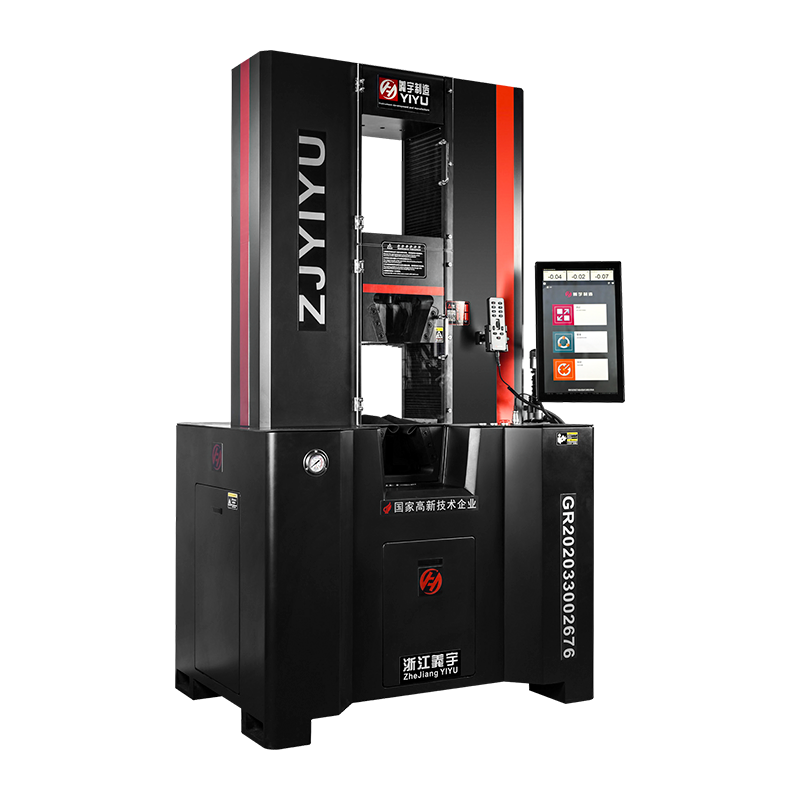
For heavy-load applications above 300 kN, servo-hydraulic UTMs use a hydraulic actuator controlled by a servo valve for precise force application. They can deliver dynamic and fatigue loading in addition to static tests—making them the only choice for aerospace, automotive, and structural engineering fatigue testing where cyclic loading at hundreds of hertz is required.
Load Cell Accuracy in UTMs
High-quality UTMs achieve load measurement accuracy of ±0.5% of indicated load per ISO 7500-1 Class 0.5, and crosshead displacement accuracy within ±1 µm using optical encoders. This level of precision is unnecessary for concrete compression testing, which is why a UTM is overspecified—and overpriced—for routine construction QC work.
How Compression Testing Machines Work: Hydraulic Precision for High Loads
A CTM applies compressive force by pumping hydraulic fluid into a cylinder beneath the lower platen (or above the upper platen), which pushes the platens together at a controlled rate. The applied force is measured by a load cell or read from a calibrated hydraulic pressure gauge.
Manual vs. Auto-Controlled CTMs
Entry-level CTMs use a manual valve to control oil flow rate, relying on the operator to maintain a consistent loading rate (typically 0.2–0.4 N/mm² per second as specified by IS 516 and BS EN 12390-3). More advanced digital CTMs use a servo-controlled hydraulic pump with a programmable loading rate, eliminating operator error and providing digital data capture for automated report generation.
Platen Spherical Seating
A critical design feature of a quality CTM is the spherically seated upper platen. This allows the platen to self-align with the specimen surface when specimens are not perfectly flat or parallel, ensuring even load distribution and preventing eccentric loading that would give falsely low strength readings. Misalignment of even 1–2 mm can reduce measured compressive strength by 10–15%.
Can a UTM Replace a CTM for Concrete Testing?
Technically yes—a UTM with sufficient compressive capacity (500 kN or more) and appropriate platens can perform concrete cube compression tests. However, this is rarely the practical choice for the following reasons:
- Cost: A 2,000 kN UTM capable of testing 150 mm concrete cubes costs $40,000–$120,000. A dedicated 2,000 kN CTM achieving the same result costs $5,000–$20,000.
- Debris and contamination: Concrete cube failure is explosive, generating fragments and fine dust that can damage the precision load cell and crosshead mechanism of a UTM.
- Throughput: CTMs in busy construction labs run 50–100 cube tests per day. A UTM's complex setup and software interface is inefficient for this repetitive, single-parameter workflow.
- Standard compliance: Some testing standards and accreditation bodies specify that concrete compression tests must be conducted on machines conforming to BS EN 12390-4 or IS 14858, which are CTM-specific standards.
The reverse question—can a CTM replace a UTM for metal tensile testing?—has a clear answer: no. A CTM physically cannot apply tensile force, measure elongation, or generate a stress-strain curve.
Choosing Between a UTM and a CTM: A Practical Decision Guide
The right machine depends entirely on your testing scope, material types, standards compliance requirements, and budget. Use the following criteria to guide your decision:
Choose a UTM if:
- You test multiple material types (metals, plastics, rubber, composites) or need both tensile and compressive data.
- Your work requires complete stress-strain curves, Young's modulus, yield strength, and elongation data.
- You operate in R&D, quality assurance for manufactured parts, or aerospace and automotive industries.
- Your testing standards include ASTM E8, ISO 6892, ASTM D638, or similar multi-parameter mechanical test standards.
Choose a CTM if:
- Your sole or primary requirement is concrete, brick, or cement mortar compressive strength testing.
- You operate a construction site laboratory, ready-mix concrete plant, or civil engineering QC facility.
- You need to process high volumes of specimens (30–100+ tests per day) efficiently and cost-effectively.
- Budget is constrained and a dedicated high-capacity compression press meets all your compliance requirements.
Key Specifications to Evaluate When Buying Either Machine
Whether selecting a UTM or a CTM, these technical specifications determine real-world performance and long-term value:
| Specification |
What to Look for in a UTM |
What to Look for in a CTM |
| Load Accuracy |
±0.5% (ISO 7500-1 Class 0.5) |
±1–2% (IS 14858 / BS EN 12390-4) |
| Speed Control |
0.001–500 mm/min (programmable) |
0.2–0.4 N/mm²/s (load-rate controlled) |
| Data Acquisition |
Full stress-strain curve, export to CSV/PDF |
Peak load display, optional digital readout |
| Platen/Fixture Design |
Interchangeable grip system |
Spherically seated upper platen |
| Calibration Traceability |
NABL/ISO 17025 accredited calibration |
NABL/ISO 17025 accredited calibration |
| Frame Rigidity |
Stiffness ≥ 10× rated load capacity |
Rigid welded steel frame, minimal deflection |
Key purchasing specifications for Universal Testing Machines and Compression Testing Machines
Calibration, Maintenance, and Compliance Requirements
Both UTMs and CTMs require periodic calibration to maintain accuracy and comply with test standards. Understanding the calibration schedules and maintenance needs of each helps laboratories budget for ongoing ownership costs.
UTM Calibration Requirements
- Force calibration per ISO 7500-1 or ASTM E4: annually, or after any repair or relocation.
- Displacement/extensometer calibration per ISO 9513 or ASTM E83: annually.
- Load cell verification using certified reference weights or proving rings traceable to national standards.
CTM Calibration Requirements
- Force calibration per BS EN 12390-4, IS 14858, or ASTM C39: every 12 months and after major repairs.
- Platen flatness and parallelism check: every 6 months or after 10,000+ test cycles.
- Hydraulic oil and seal inspection: every 500–1,000 operating hours to prevent load cell pressure drift.
For laboratories seeking NABL accreditation or ISO 17025 compliance, both machine types must have documented calibration records with uncertainty budgets. CTMs are generally less costly to calibrate than UTMs due to their simpler single-axis, single-mode measurement system.

 简体中文
简体中文
 English
 русский