What Are Specialized Testing Machines and Why Do They Matter?
Specialized testing machines are purpose-built instruments designed to evaluate specific material properties, product performance, or component integrity under controlled, repeatable conditions. Unlike general-purpose laboratory equipment, each specialized testing machine is engineered around a narrow set of test parameters — tensile load, impact energy, fatigue cycles, hardness, or environmental stress — delivering measurement accuracy and repeatability that generic equipment simply cannot match.
Their importance is straightforward: product failures in aerospace, automotive, medical devices, and construction are rarely caused by unknown material behavior — they are caused by inadequate testing before deployment. A single recalled product batch can cost manufacturers 10 to 100 times more than the entire investment in specialized testing equipment that would have caught the defect. Selecting and correctly using the right specialized testing machine is, in practical terms, a core engineering risk management decision.
Major Categories of Specialized Testing Machines
Specialized testing machines span dozens of industry segments. The broadest and most industrially significant categories are outlined below, each addressing a distinct class of failure mode or material characteristic.
| Category |
What It Measures |
Typical Industries |
Key Standards |
| Universal Testing Machines (UTM) |
Tensile, compressive, flexural strength |
Metals, plastics, composites, textiles |
ASTM E8, ISO 6892 |
| Fatigue Testing Machines |
Cyclic load endurance, S-N curves |
Aerospace, automotive, biomedical implants |
ASTM E466, ISO 1099 |
| Impact Testing Machines |
Absorbed impact energy, toughness |
Structural steel, polymers, packaging |
ASTM E23, ISO 148 |
| Hardness Testing Machines |
Surface resistance to deformation |
Heat treatment, tooling, castings |
ASTM E18, ISO 6508 |
| Environmental / Climatic Test Chambers |
Performance under temperature, humidity, UV |
Electronics, automotive, defense |
IEC 60068, MIL-STD-810 |
| Tribology / Wear Testing Machines |
Friction coefficient, wear rate, lubrication |
Bearings, coatings, seals, gears |
ASTM G99, ISO 7148 |
| Non-Destructive Testing (NDT) Machines |
Internal defects without destroying samples |
Welds, pressure vessels, pipelines |
ASME V, EN 1435 |
Overview of the primary specialized testing machine categories, what each measures, typical industry applications, and governing standards.
Universal Testing Machines: The Workhorse of Materials Testing
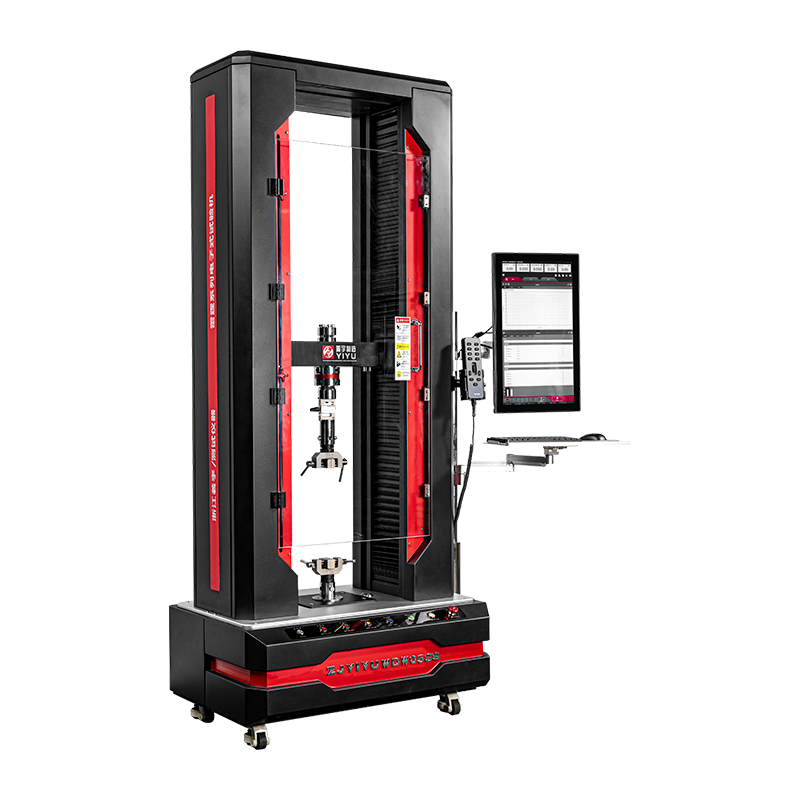
Universal testing machines (UTMs) are the most widely deployed specialized testing machines across manufacturing and research. Despite their name, they are specialized in the sense that every configuration decision — load cell capacity, crosshead speed, gripping system, and extensometer type — must be matched to the specific material and test standard being executed.
Electromechanical vs Hydraulic UTMs
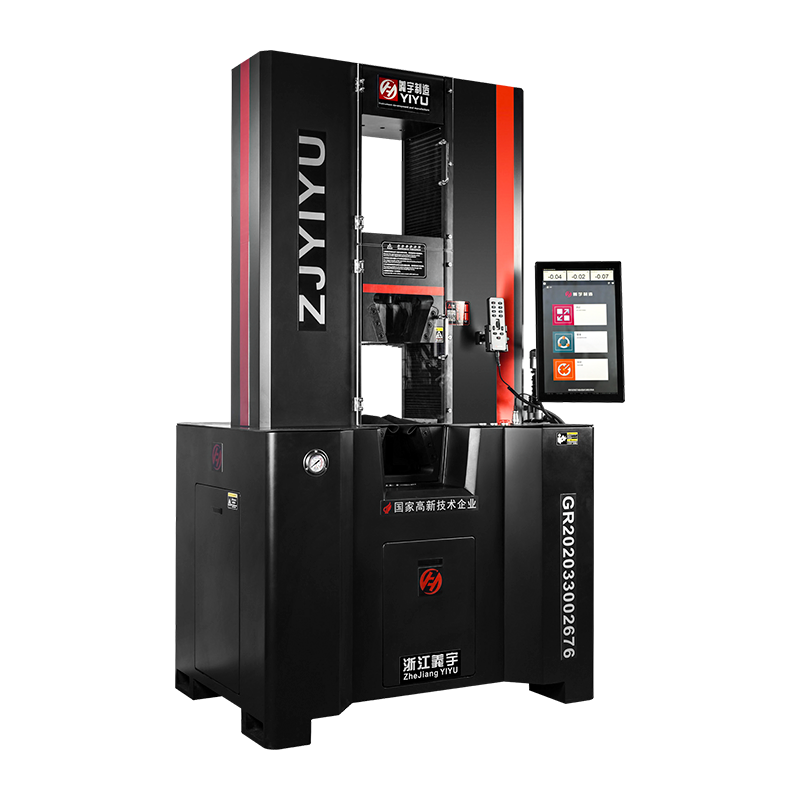
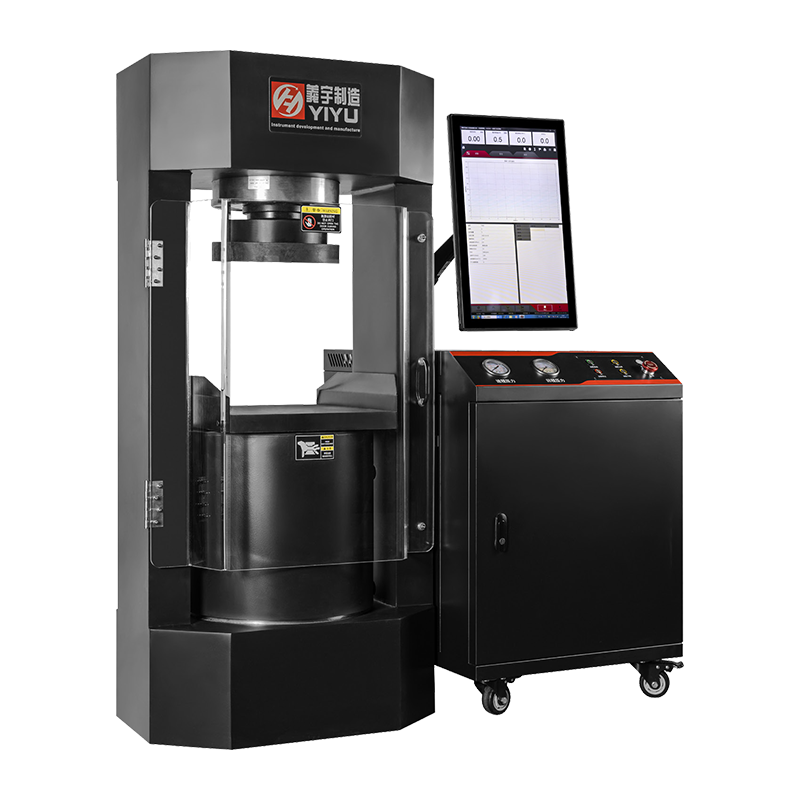
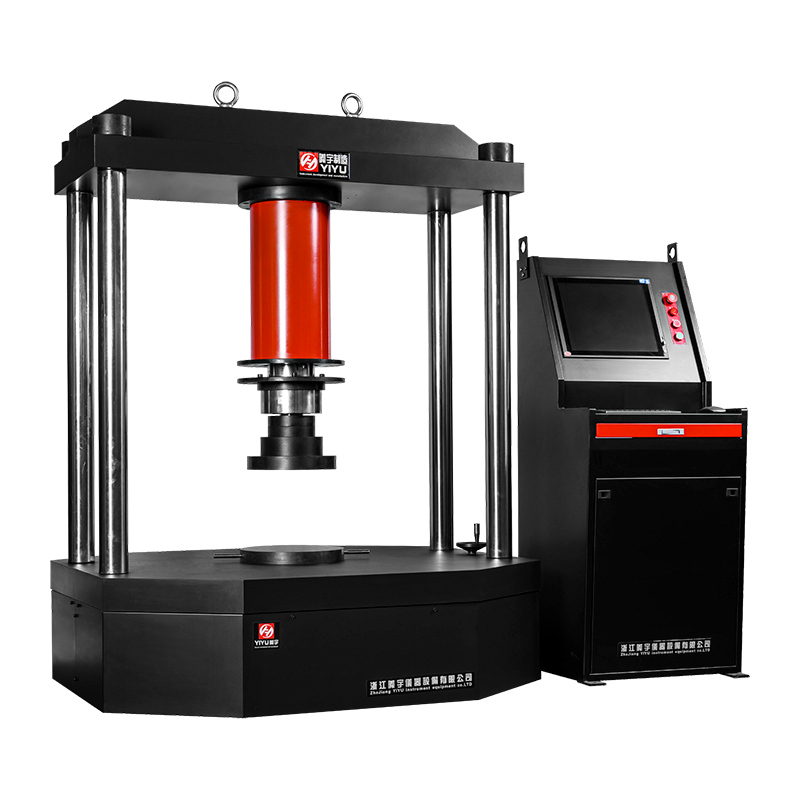
Electromechanical UTMs use a servo motor and ball screw drive to apply load. They excel at precision low-to-medium force applications (up to approximately 300 kN), offering excellent crosshead speed control from 0.001 mm/min to 500 mm/min and clean, programmable test profiles. Hydraulic UTMs apply load via a hydraulic actuator and are preferred for very high force requirements — typically 500 kN to 3,000 kN — used in structural steel, concrete, and heavy component testing. Hydraulic systems are less energy-efficient but unmatched for brute-force structural testing.
Load Cell Selection and Accuracy
A UTM's load cell must be sized appropriately — not just for maximum load, but for the minimum measurable load. Testing a 50 N textile sample on a 100 kN load cell produces unreliable data because the sample force falls below the cell's calibrated measurement range (typically the lower 1–2% of full scale). Best practice is to match the expected peak test force to 50–90% of the load cell's rated capacity. Leading UTM manufacturers — Instron, Zwick Roell, MTS Systems, and Shimadzu — all offer interchangeable load cell families for this reason.
Extensometers and Strain Measurement
Accurate strain measurement requires an extensometer attached directly to the gauge section of the specimen — not crosshead displacement, which includes machine compliance errors. Contact extensometers clip onto the specimen; non-contact video extensometers (now standard on premium UTMs) use digital image correlation to track strain without specimen contact, eliminating the risk of the extensometer itself influencing failure location in brittle materials.
Fatigue Testing Machines: Predicting Long-Term Component Life
Fatigue is responsible for an estimated 50–90% of all mechanical failures in engineering components, yet fatigue behavior cannot be predicted from static tensile data alone. Fatigue testing machines apply repeated cyclic loads to specimens or complete assemblies, generating the S-N (stress vs. cycles to failure) data that underpins safe life and damage tolerance design calculations.
Servo-Hydraulic Fatigue Systems
Servo-hydraulic fatigue machines dominate high-force applications and are capable of applying fully programmable, variable-amplitude load spectra at frequencies of 0.01–100 Hz. They are the standard for aerospace component testing (turbine blades, landing gear, wing spars) and automotive durability validation. A modern servo-hydraulic fatigue system from MTS or Instron can run 10⁷ to 10⁸ load cycles for endurance limit determination — a test that may run continuously for weeks or months.
Resonance and High-Frequency Fatigue Machines
For high-cycle fatigue testing where millions or billions of cycles are required, resonance fatigue machines (such as Amsler vibrophores) and ultrasonic fatigue machines operating at 20 kHz dramatically reduce test duration. A test that requires 6 months at 100 Hz can be completed in under 24 hours at 20 kHz — enabling very high-cycle fatigue (VHCF) data collection that was previously impractical. These machines are particularly valuable in biomedical implant testing (hip stems, spinal fixation hardware) and high-performance alloy characterization.
Multiaxial Fatigue Test Rigs
Real-world components rarely experience simple uniaxial fatigue. Multiaxial fatigue rigs apply simultaneous bending, torsion, and axial loads in programmable phase relationships, replicating complex in-service load paths on components like crankshafts, suspension arms, and drive shafts. These systems represent some of the most complex and expensive specialized testing machines, with high-specification rigs costing $500,000 to over $2 million.
Impact Testing Machines: Measuring Toughness and Fracture Resistance
Impact testing machines measure a material's ability to absorb energy during rapid fracture — a property called toughness that is distinct from strength and ductility and cannot be derived from quasi-static tensile tests.
Charpy and Izod Impact Testers
Charpy and Izod pendulum impact testers are the most standardized impact testing machines globally. The Charpy test strikes a notched specimen from behind (simply supported at both ends); the Izod test strikes a vertically clamped, cantilevered specimen from the front. Both measure absorbed energy in joules. The Charpy test is dominant in Europe and for structural steel qualification; Izod is more common for plastics testing in North America. Modern instrumented Charpy machines extend beyond simple energy measurement to record force-displacement curves at rates up to 1 m/s, enabling dynamic fracture toughness determination per ASTM E1820.
Drop Weight and Falling Dart Impact Testers
Drop weight testers are used for large panels, films, and packaging where a pendulum geometry is unsuitable. A dart or tup of defined mass is dropped from a controlled height onto the specimen, and the energy absorbed before perforation is calculated. These machines are particularly important for automotive plastic panel qualification (FMVSS 201 pedestrian safety tests) and flexible packaging impact resistance per ASTM D1709.
Hardness Testing Machines: Quick, Non-Destructive Surface Evaluation
Hardness testing is one of the most frequently performed mechanical tests in manufacturing quality control because it is fast (results in under 60 seconds), causes minimal specimen damage, and correlates empirically to tensile strength for many steels — a 1 HRC point change corresponds to approximately 3.3 MPa in tensile strength for medium carbon steels.
- Rockwell hardness testers: Apply a minor preload followed by a major load using a diamond cone (HRC scale) or ball indenter (HRB scale). The hardness number is derived from indentation depth. Results are direct-reading and highly repeatable — ideal for production floor QC.
- Vickers hardness testers: Use a square-based diamond pyramid indenter at loads from 1 gf (micro-Vickers) to 30 kgf. The indentation diagonal is measured optically. Vickers testing covers the widest range of materials — from soft gold foil to hardened tool steel — and is preferred where consistent scale across different hardness levels is needed.
- Brinell hardness testers: Press a 10 mm carbide ball into the specimen under loads of 500–3,000 kgf. The large indentation averages out local microstructural variations, making Brinell ideal for coarse-grained materials like castings, forgings, and large structural sections.
- Micro-hardness and nano-indentation machines: Apply loads as low as 0.1 mN to measure hardness of individual microstructural phases, thin coatings, or very small components like watch gears or medical wire. These instruments represent the most specialized end of the hardness testing machine spectrum.
Environmental and Climatic Test Chambers: Simulating Real-World Conditions
Products that pass mechanical testing at room temperature often fail prematurely when exposed to temperature extremes, humidity cycles, UV radiation, or salt spray. Environmental test chambers are specialized testing machines that replicate these conditions in an accelerated, controlled manner — compressing years of field exposure into days or weeks of laboratory testing.
Temperature and Humidity Chambers
Walk-in and bench-top temperature/humidity chambers cycle products through programmed temperature and relative humidity profiles. Standard electronic product qualification per IEC 60068-2-78 involves exposure at 40°C / 93% RH for 56 days. Automotive interior components are tested per VDA 230-210 at up to 90°C to validate paint adhesion, dimensional stability, and plastic creep resistance. Thermal shock chambers add rapid transfer between hot and cold zones (e.g., −55°C to +125°C in under 30 seconds) to simulate the extreme thermal cycling experienced by electronics in aerospace applications.
Salt Spray and Corrosion Test Chambers
Salt spray (salt fog) chambers expose coated metal components to a 5% sodium chloride mist at 35°C to accelerate corrosion and evaluate coating quality. Per ASTM B117, standard salt spray testing durations range from 96 hours for basic primers to 1,000+ hours for automotive body panel coatings. Cyclic corrosion testing (CCT) chambers, which alternate between salt spray, dry, and humid phases, have largely replaced neutral salt spray for automotive specification compliance because they better replicate real-world corrosion mechanisms.
Vibration and Shock Test Systems
Electrodynamic shakers and hydraulic vibration tables apply controlled sinusoidal, random, or shock vibration profiles to products and assemblies. Military electronics qualification per MIL-STD-810H involves random vibration at spectral densities up to 0.04 g²/Hz across 20–2,000 Hz for extended durations. Combined environment testing — simultaneous vibration and thermal cycling — is now standard for satellite components, avionics, and automotive ECUs.
Industry-Specific Specialized Testing Machines Worth Knowing
Beyond the broad categories above, many industries rely on highly specialized testing machines that address unique failure modes or regulatory requirements specific to their sector.
| Industry |
Specialized Testing Machine |
What It Tests |
Key Standard |
| Textile / Apparel |
Martindale Abrasion Tester |
Fabric pilling and wear resistance |
ISO 12947 |
| Packaging |
Box Compression Tester (BCT) |
Corrugated box stacking strength |
ASTM D642, ISO 12048 |
| Biomedical |
Spine / Hip Simulator |
Implant wear and fatigue life |
ISO 14242, ASTM F2423 |
| Rubber / Elastomers |
Mooney Viscometer |
Raw rubber processability and cure rate |
ASTM D1646, ISO 289 |
| Civil Engineering |
CBR Testing Machine |
Subgrade and pavement bearing capacity |
ASTM D1883, BS 1377 |
| Electronics |
HALT / HASS Chamber |
Accelerated life testing of PCBs and assemblies |
IPC-9592B |
| Food & Pharma |
Texture Analyser |
Gel strength, tablet hardness, bite force |
USP <1217>, AACC 56-11 |
Selected industry-specific specialized testing machines with their measurement purpose and applicable test standards.
How to Select the Right Specialized Testing Machine for Your Application
Procurement of a specialized testing machine is not a catalogue decision. Machines that appear similar on a specification sheet can deliver dramatically different results depending on how well they are matched to your actual test requirements. The following structured approach minimizes costly mismatches.
- Define the test standard first, not the machine. Identify which ASTM, ISO, EN, or industry standard your test must comply with. The standard dictates specimen geometry, loading rate, temperature, and acceptance criteria — which in turn determines machine specifications. Buying a machine then finding a standard to match it is a common and expensive mistake.
- Establish force and displacement ranges with margin. Calculate the expected peak force and displacement of your test, then specify a machine with capacity 20–30% above your maximum requirement. This ensures you operate in the machine's most accurate measurement range while retaining headroom for unexpected specimen variability.
- Evaluate calibration and traceability requirements. If test results will be used for regulatory submission (FDA, CE marking, aerospace certification), your machine must be calibrated to a national standard with a documented traceability chain. Confirm the supplier provides ISO/IEC 17025-accredited calibration certificates, not just factory calibration.
- Assess software compliance with 21 CFR Part 11 if required. Pharmaceutical and medical device testing often requires electronic records and signatures compliant with FDA 21 CFR Part 11 or EU Annex 11. Not all testing machine software platforms support this; confirm compliance during the specification phase, not after purchase.
- Request a demonstration with your actual material. Reputable specialized testing machine manufacturers will run demonstration tests with samples you provide. Never commit to a major purchase without seeing the machine perform your specific test — variances in gripping, specimen geometry, and control loop behavior become apparent only with real samples.
- Evaluate total cost of ownership, not purchase price. Factor in calibration costs (typically $500–$3,000 annually), consumable grips and fixtures, software maintenance licenses, preventive maintenance contracts, and expected service life. A machine priced 20% lower at purchase may cost 40% more over a 10-year operating life if local service support is inadequate.
Calibration, Accreditation, and Data Integrity in Specialized Testing
A specialized testing machine is only as reliable as its calibration status. Machines drift over time — load cells fatigue, displacement transducers shift, temperature sensors drift — and uncalibrated machines produce data that appears credible but is systematically wrong.
ISO/IEC 17025 Laboratory Accreditation
ISO/IEC 17025 is the international standard for testing laboratory competence. Accreditation confirms that a laboratory's testing machines are properly calibrated, its staff are competent, and its test methods are valid. Many aerospace, automotive, and defense contracts now require ISO/IEC 17025 accredited test data — not just internally calibrated results. If your test data will support product certification, regulatory submission, or litigation, ISO/IEC 17025 accreditation for the performing laboratory is effectively non-negotiable.
Calibration Intervals and Machine Verification
Annual calibration is a minimum baseline. High-use machines in production environments — running 2,000+ test hours per year — should be calibrated every 6 months or after any event that could affect measurement accuracy (dropped load cell, software upgrade, machine relocation). Daily machine verification using reference weights or certified verification blocks, taking under 5 minutes, catches calibration drift before it corrupts an entire batch of test data.
Digital Data Integrity and Audit Trails
Modern specialized testing machine software stores raw force-displacement data, test parameters, operator IDs, and calibration status in tamper-evident digital records. For regulated industries, audit trails that log every data edit with a timestamp and reason code are a regulatory requirement, not an optional feature. When evaluating testing machine software, verify that raw data files cannot be overwritten and that the system generates automatic backup copies of every completed test record.

 简体中文
简体中文
 English
 русский