A Universal Testing Machine (UTM) performs tension, compression, bending, shear, and peel tests on a single platform — a compression testing machine performs only compressive loading. The UTM is the more capable and more expensive instrument: its dual-column or four-column frame, bidirectional actuator, and interchangeable grip system allow it to reverse force direction and accommodate virtually any test geometry. A compression testing machine is purpose-built for downward compressive load only — it has no mechanism to apply tensile force, making it lower cost, simpler to operate, and more suitable for high-volume compression-specific testing such as concrete cube testing, brick testing, and packaging compression. If your laboratory tests materials in tension or bending in addition to compression, a UTM is the correct choice. If your work is exclusively compressive — particularly high-load structural materials like concrete and masonry — a dedicated compression tester provides better value and often higher force capacity per dollar.
Core Design Differences: What Each Machine Is Built to Do
Universal Testing Machine Architecture
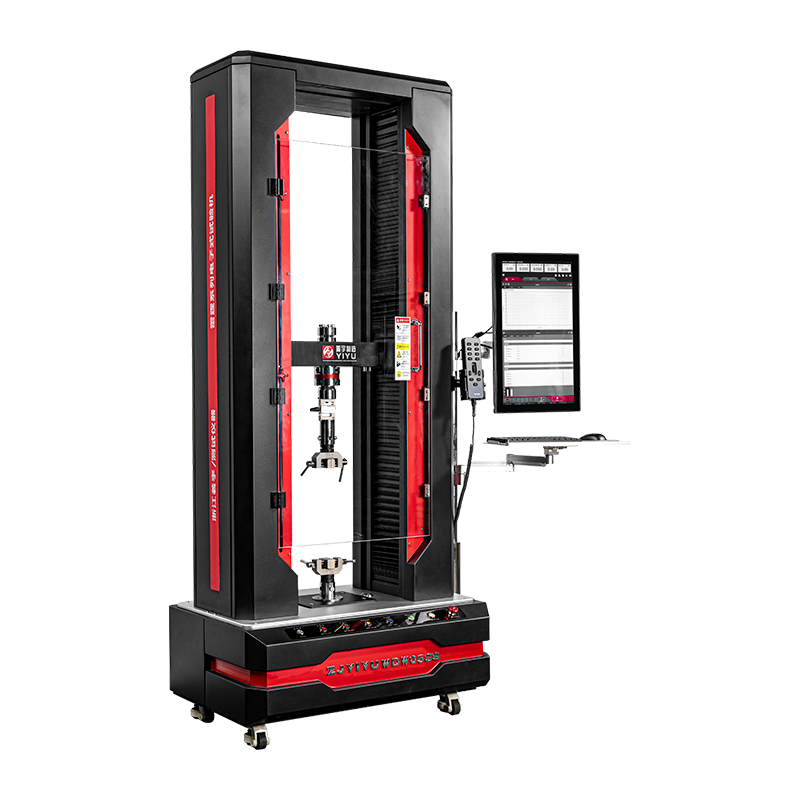
A UTM is built around a structural frame — typically two or four load-bearing columns — that supports a fixed crosshead at the top and a movable crosshead driven by lead screws, hydraulic cylinders, or a belt-and-pulley system. The actuator is bidirectional: it can move the crosshead both upward (tension) and downward (compression) with equal force capacity. The load cell is mounted inline between the actuator and the grips, measuring force in both directions. This symmetric, bidirectional design is what makes the machine "universal."
The test space between crossheads is accessible from both sides, allowing long specimens to be loaded axially. Upper and lower grips or fixtures are interchangeable — the same machine can hold a 6mm wire in tensile grips, compress a foam block between flat platens, or bend a beam across three-point bend fixtures, simply by swapping the tooling. UTMs range from 100 N benchtop units for packaging and films up to 2,000 kN floor-standing machines for structural steel and concrete.
Compression Testing Machine Architecture
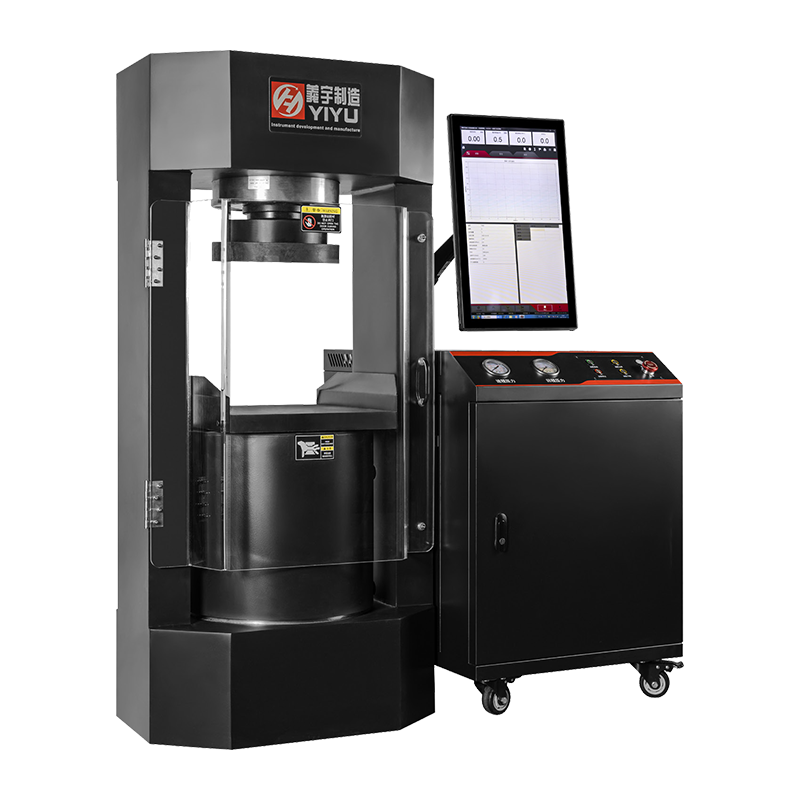
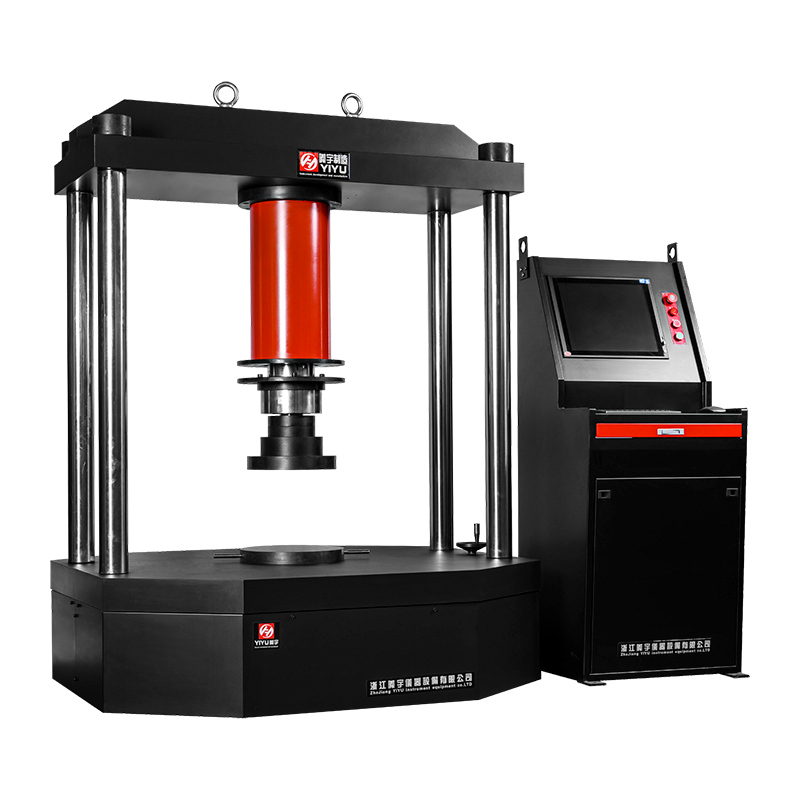
A compression testing machine (CTM) — also called a concrete compression tester or cube press — consists of a rigid base frame, a fixed lower platen, and an upper platen driven downward by a hydraulic jack or electromechanical actuator. The loading direction is unidirectional: the upper platen descends and the specimen is crushed between the two platens. There is no mechanism to reverse the actuator and apply upward tensile force.
CTMs are optimized for high-force compressive tests on rigid specimens. Because the frame only needs to resist compressive reaction forces (not tensile), it can be made with a shorter, more compact structure that is inherently stiffer — critical for accurate measurement when testing brittle materials that fracture explosively. Standard CTMs for concrete testing range from 1,000 kN to 3,000 kN, with specialist machines reaching 5,000 kN (500 tonnes) for rock and large aggregate specimens. These force levels are rarely available in UTMs of equivalent price.
Test Types: What Each Machine Can and Cannot Do
Test capability comparison between Universal Testing Machines and Compression Testing Machines across common mechanical test types
| Test Type |
UTM |
Compression Testing Machine |
Relevant Standard |
| Tensile (metals) |
Yes |
No |
ISO 6892-1, ASTM E8 |
| Tensile (plastics, rubber) |
Yes |
No |
ISO 527, ASTM D638 |
| Compression (metals, plastics) |
Yes |
Yes |
ISO 604, ASTM D695 |
| Compression (concrete, masonry) |
Yes (limited force) |
Yes (primary use) |
EN 12390-3, ASTM C39 |
| 3-point and 4-point bend |
Yes |
Limited (with fixtures) |
ISO 178, ASTM D790 |
| Flexural strength (concrete beam) |
Yes |
Yes (with beam fixtures) |
ASTM C78, EN 12390-5 |
| Peel and adhesion |
Yes |
No |
ASTM D903, ISO 8510 |
| Shear strength |
Yes |
No |
ASTM B831, ISO 14129 |
| Fatigue (cyclic loading) |
Yes (servo-hydraulic UTM) |
No |
ISO 1099, ASTM E466 |
| Packaging compression / box crush |
Yes |
Yes |
ASTM D642, ISO 12048 |
Force Range and Frame Stiffness: Where the Machines Diverge
Force range is one of the sharpest distinctions between the two machine types in practice. UTMs serving general materials testing laboratories are most commonly specified in the 5 kN to 600 kN range. A 600 kN UTM capable of tensile testing structural steel costs significantly more than a 3,000 kN compression tester serving a concrete testing laboratory — because the UTM's bidirectional frame, precision servo control, and extensometer interface add substantial cost that a hydraulic CTM does not need.
Frame stiffness is another critical parameter. When a brittle specimen such as a concrete cube fractures explosively, the energy stored in a compliant (low-stiffness) frame is released suddenly, continuing to crush the specimen beyond its natural fracture point and producing artificially low strength readings. EN 12390-4 and ASTM C39 specify minimum frame stiffness requirements for concrete compression testing — typically expressed as a deflection limit under maximum load. Dedicated CTMs are specifically designed to meet these stiffness requirements. Many general-purpose UTMs, particularly electromechanical screw-driven models, have insufficient frame stiffness for accurate concrete compression testing at high loads.
Actuation Systems: Electromechanical vs. Hydraulic
Both UTMs and compression testing machines are available in electromechanical (EM) and hydraulic variants, but the typical configurations differ between the two instrument types.
Electromechanical UTMs
Most laboratory UTMs below 600 kN are electromechanical: an electric servo motor drives lead screws or ballscrews to move the crosshead. This provides precise crosshead displacement control — position accuracy of ±0.1 mm or better — and constant crosshead speed from 0.001 mm/min to 1,000 mm/min across the full load range. EM drive is cleaner (no hydraulic oil), quieter, and requires less routine maintenance than hydraulic systems. The limitation is maximum force: lead screw-driven UTMs above 600 kN become very large, slow, and expensive.
Hydraulic UTMs and Compression Testers
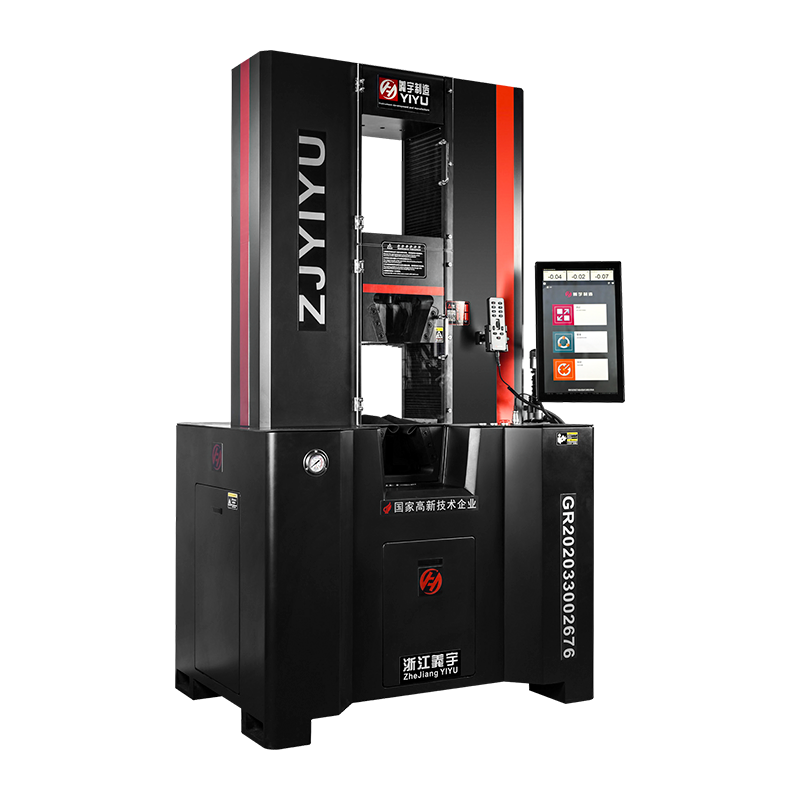
Above 600 kN, hydraulic actuation dominates both UTMs and CTMs. A hydraulic pump pressurizes oil to move a piston/ram. This produces very high forces in a compact actuator — a hydraulic ram generating 2,000 kN fits in a cylinder roughly 250mm in diameter. Hydraulic systems provide excellent force control for load-controlled tests (standard in concrete testing, where load rate in kN/s is specified rather than displacement rate). The disadvantage is that position control is less precise than electromechanical, oil requires periodic replacement and leak management, and the pump generates heat and noise.
Servo-hydraulic UTMs — used in fatigue and dynamic testing — combine hydraulic force capacity with closed-loop servo control for both force and displacement. These are specialist high-cost instruments typically found in research and aerospace testing environments rather than routine quality control laboratories.
Grip and Fixture Systems: Versatility vs. Simplicity
A UTM's versatility comes largely from its fixture ecosystem. The machine's crossheads have threaded or clevis-style attachment points that accept interchangeable grips and fixtures:
- Wedge-action tensile grips — self-tightening jaws that grip flat or round specimens; available in smooth jaw (for soft materials) or serrated jaw (for hard materials); the most common UTM accessory
- Compression platens — flat hardened steel plates for compressing blocks, cylinders, and specimens; these convert the UTM into a compression tester for non-concrete applications
- Three-point and four-point bend fixtures — roller-based supports and loading noses for flexural tests; span distances are adjustable to match specimen dimensions specified in test standards
- Peel fixtures — rotating arm or T-peel fixtures for adhesive and film peel tests at defined angles (90°, 180°, T-peel)
- Extensometers — clip-on or non-contact devices that measure specimen elongation independently of crosshead displacement, providing accurate strain measurement for Young's modulus and yield strength determination
A compression testing machine by contrast typically has only one fixture configuration: upper and lower platens. Concrete CTMs per EN 12390-4 specify a spherically seated upper platen that self-levels to accommodate minor specimen non-parallelism — a critical accuracy feature for concrete cube testing. Some CTMs accept optional beam-testing fixtures, but the fixture range is a fraction of what a UTM supports.
Measurement and Control: Load Cells, Extensometers, and Software
Load Cell Accuracy and Range
UTMs typically use interchangeable load cells — a laboratory may have a 1 kN cell for film and adhesive testing and a 100 kN cell for metal testing, each with its own calibration. Load cell accuracy is critical: ASTM E4 and ISO 7500-1 specify that testing machine force accuracy must be within ±1% of the indicated force across the range from 2% to 100% of load cell capacity. Most modern UTM load cells achieve ±0.5% or better accuracy across their rated range.
Compression testing machines for concrete use load cells or pressure transducers calibrated per EN 12390-4, which requires accuracy within ±2% of the applied force across the range from 20% to 100% of maximum capacity. The wider tolerance reflects the inherent variability in concrete specimen geometry and surface preparation, where measurement precision beyond 2% is not practically meaningful.
Software Capabilities
UTM software is necessarily more complex than CTM software because it must handle multiple test types, strain calculation from extensometer data, and the derivation of material properties (Young's modulus, yield strength, ultimate tensile strength, elongation at break, fracture toughness). Leading UTM software platforms from Instron (Bluehill), Zwick/Roell (testXpert), and MTS (TestSuite) provide programmable test methods, automatic material property calculation, statistical reporting across specimen batches, and integration with LIMS (Laboratory Information Management Systems).
CTM software for concrete is simpler by design: the operator enters the specimen cross-section dimensions, the machine applies load at the specified rate (typically 0.5 ± 0.25 MPa/s per EN 12390-3), records peak force at fracture, and calculates compressive strength as force divided by cross-sectional area. The result is a single number in MPa or psi — no stress-strain analysis, no modulus calculation.
Comprehensive Side-by-Side Comparison
Direct comparison of Universal Testing Machines and Compression Testing Machines across key technical, operational, and commercial parameters
| Parameter |
Universal Testing Machine (UTM) |
Compression Testing Machine (CTM) |
| Loading direction |
Bidirectional (tension + compression) |
Unidirectional (compression only) |
| Typical force range |
100 N – 2,000 kN |
100 kN – 5,000 kN |
| Primary actuation |
Electromechanical (<600 kN); Hydraulic (>600 kN) |
Hydraulic (dominant); EM for lower-force models |
| Crosshead displacement control |
Precise (±0.1 mm EM; ±0.5 mm hydraulic) |
Moderate (load-rate controlled; position secondary) |
| Fixture versatility |
Very high (grips, platens, bend fixtures, peel jigs) |
Low (platens only; optional beam fixtures) |
| Frame stiffness |
Good; may be insufficient for high-force brittle tests |
Very high; designed for brittle fracture tests |
| Load cell accuracy |
±0.5% (ISO 7500-1 Class 0.5 achievable) |
±1–2% (EN 12390-4 Class 1 or 2) |
| Software complexity |
High (multi-test, extensometer, LIMS integration) |
Low (peak force, compressive strength output) |
| Operator skill required |
Moderate to High |
Low to Moderate |
| Typical purchase cost |
$15,000 – $150,000+ (force and spec dependent) |
$5,000 – $60,000 (for equivalent force capacity) |
| Relevant standards |
ISO 6892, ASTM E8, ISO 527, ISO 178, etc. |
EN 12390-3, ASTM C39, BS EN 196-1 |
| Fatigue / cyclic testing |
Yes (servo-hydraulic models) |
No |
Industry Applications: Who Uses Which Machine
Industries Primarily Using UTMs
- Metals and manufacturing — tensile testing of steel, aluminum, copper, and welds to ISO 6892 and ASTM E8 is the most common UTM application globally; yield strength, tensile strength, and elongation are mandatory quality parameters for structural materials
- Plastics and polymers — tensile, flexural, and compression tests on molded parts, films, and fibers per ISO 527, ISO 178, and ASTM D638; the pharmaceutical industry uses UTMs for tablet hardness and capsule seal strength
- Textiles and geotextiles — tensile strength and elongation of fabrics, yarns, and geomembrane liners; peel and seam strength of bonded textiles
- Aerospace and automotive — structural component testing, composite laminate tensile and compression, adhesive joint testing, fastener pull-out; often require specialized fixtures and environmental chambers (elevated temperature, cryogenic)
- Packaging — carton and corrugated board compression, film tensile and tear, seal peel strength, bottle crush; UTMs in packaging labs often run 50–100 tests per day across multiple test types
Industries Primarily Using Compression Testing Machines
- Construction materials testing laboratories — concrete cube and cylinder compression testing is the most common quality control test in the construction industry; a typical site laboratory may test 50–200 concrete cubes per day, making CTM throughput and simplicity critical
- Cement manufacturing — compressive strength of cement mortar cubes per EN 196-1 and ASTM C109 is the primary quality parameter for cement production; dedicated mortar testing CTMs run continuously in cement plant quality labs
- Masonry and ceramics — compressive strength of bricks, blocks, tiles, and refractory ceramics per EN 772-1, ASTM C67; these tests require the high force capacity and stiff frames of dedicated CTMs
- Rock mechanics and geotechnical engineering — uniaxial compressive strength (UCS) testing of rock core specimens per ISRM and ASTM D7012; rock specimens at high confining pressures require CTMs with forces up to 5,000 kN
When a UTM Can Replace a Compression Tester (and When It Cannot)
A UTM with compression platens can perform many of the same tests as a dedicated compression tester for metals, plastics, foams, and packaging. The question is whether it is appropriate for concrete and masonry testing, which is where most purchasing decisions pivot.
A UTM is appropriate for concrete compression testing only if:
- Its force capacity covers the expected peak load — a 150mm standard concrete cube with 30 MPa design strength requires approximately 675 kN peak force; a 200mm cube requires 1,200 kN; most UTMs below 1,000 kN are inadequate for routine concrete cube testing
- Its frame stiffness meets the requirements of the applicable standard (EN 12390-4 or ASTM C39); this must be verified with the manufacturer, not assumed
- Its upper platen has a spherical seating mechanism per standard requirements
- The calibration authority covers the compression mode specifically — a UTM calibrated per ISO 7500-1 for tensile testing is not automatically compliant for concrete compression testing under EN 12390-4
For low-volume research applications — occasional concrete specimen testing in a university laboratory with a variety of other test needs — a high-capacity UTM with appropriate compression fixtures is a practical choice that avoids purchasing two machines. For a commercial concrete testing laboratory running high volumes daily, a dedicated CTM is more cost-effective, faster to operate, and purpose-calibrated for exactly that work.
Calibration, Standards, and Accreditation Requirements
Both UTMs and CTMs must be periodically calibrated by an accredited calibration body to verify force accuracy. The applicable standards differ:
- ISO 7500-1 / ASTM E4 — the international and US standards for calibrating the force-measuring system of testing machines; defines accuracy classes (Class 0.5 = ±0.5%, Class 1 = ±1%, Class 2 = ±2%); applies to UTMs and any force measurement instrument
- EN 12390-4 — specifically addresses compression testing machines used for concrete; requires verification of platen flatness and hardness, spherical seating function, and load application rate accuracy in addition to force accuracy; laboratories testing concrete to EN 12390-3 must calibrate their CTM to this standard specifically
- Calibration frequency — ISO/IEC 17025-accredited laboratories typically calibrate annually; high-use or high-consequence testing environments (nuclear, aerospace) may require semi-annual calibration; calibration should always follow any significant machine repair, relocation, or suspected overload event
For ISO/IEC 17025 laboratory accreditation, the scope of accreditation specifies which tests and force ranges are covered. A laboratory accredited for tensile testing of metals with a UTM is not automatically accredited for concrete compression testing with the same machine — the test methods, standards, and calibration requirements are assessed independently.
Decision Guide: Which Machine to Buy
Use the following criteria to determine which instrument is appropriate for your testing requirements:
- Do you need tensile testing? If yes — for metals, plastics, textiles, films, or adhesives — a UTM is mandatory. Compression-only machines cannot perform tensile tests under any configuration.
- Is your primary work concrete, masonry, or rock compression? If yes, and your required force exceeds 600 kN, a dedicated CTM will provide higher force capacity at lower cost and is specifically designed and calibrated for these materials.
- What is your test volume? High-volume concrete testing (50+ specimens per day) benefits from a dedicated CTM's simpler operation and faster cycle time. Research or low-volume testing justifies the cost of a UTM that can serve multiple test types.
- What is your budget? For equivalent compressive force capacity, a CTM typically costs 30–50% less than a UTM. If your test scope is exclusively compressive, spending more for UTM capability that will never be used is not justified.
- Do you need extensometer data or stress-strain curves? If material property characterization (modulus, yield point, fracture energy) is required, a UTM with extensometer is necessary. CTMs produce only peak force and compressive strength — not continuous force-displacement or stress-strain data.
- Will the test scope change over time? If your laboratory anticipates testing new material types or entering new markets, a UTM's versatility provides investment protection. A CTM purchase is a commitment to compressive testing for its service life.

 简体中文
简体中文
 English
 русский