Modulus of elasticity is one of those numbers that looks simple on a certificate but depends on careful work in the lab. In practical terms, it describes how much a material stretches or compresses within its linear elastic range: stress divided by strain. A steel bar and a concrete cylinder may both have an E value, yet the specimen, fixture, strain measurement, and standard behind that number are quite different. That is why the best starting point is not a machine but a clear definition of what you need to measure.
Choose the right modulus and test standard
Elastic modulus is a family of properties. Young's modulus comes from uniaxial tension or compression; shear modulus comes from torsion or shear; bulk modulus from hydrostatic loading; dynamic modulus from vibration or ultrasonic methods. The word "modulus" alone is therefore not enough. Decide whether you need static or dynamic modulus, tensile or compressive, and whether Poisson's ratio must be reported at the same time.
- Tension: metals, polymers, composites, wires, sheet materials and reinforcing bars.
- Compression: concrete, rock, ceramics, cement paste and brittle materials.
- Torsion or shear: shafts, wires and joints where shear stiffness matters.
- Dynamic: quality control or small brittle specimens where a non-destructive value is useful.
Then identify the governing standard for your material and market. Typical routes include ISO 6892-1 or ASTM E111 for tensile modulus, ASTM C469 or EN 12390-13 for static modulus of concrete, and ASTM E1876 for dynamic Young's modulus by impulse excitation. The standard defines specimen size, loading rate, conditioning and calculation details; those details are part of the result.
Prepare specimens and instrument the test correctly
A modulus result is sensitive to small errors because the calculation uses a slope, not a single peak load. Prepare the specimen according to the standard, and remove burrs, loose scale or surface irregularities that could cause gripping problems or eccentric loading.
- Measure the cross-section at three places and record the average. For a round specimen, measure diameter in two perpendicular directions.
- Mark the gauge length and mount the extensometer so that it is centred and aligned with the load axis.
- Condition the specimen at the required temperature and record temperature and humidity.
- Check the load cell, extensometer and test speed against the current calibration record.
- Apply a small preload to seat the specimen, then zero the load and strain channels.
For modulus work, crosshead displacement is often a poor strain signal because it includes machine compliance, grip seating and frame deflection. A clip-on extensometer, strain gauges or a laser extensometer gives a cleaner strain measurement. If you must use crosshead displacement, run a system-compliance correction and state that in the report.
Run a static tensile test
In a tensile test, the specimen is held in grips, the extensometer is attached over the gauge length, and load is applied at a controlled rate. Keep the rate consistent with the standard; a slower rate in the elastic region is common because it gives more reliable slope data.
- Load to a small preload and verify that the strain reading responds smoothly.
- Set the data logger to record load and strain at short intervals.
- Apply load through the elastic range; stop before yield or before the agreed upper stress.
- Check the stress-strain plot for a straight, repeatable segment. A toe region is usually seating, not modulus.
- Calculate the slope by least-squares regression over the linear portion.
Metals, polymers and composites each have their own gripping and rate requirements. For a practical walkthrough of machine settings and fixture checks, this guide on how to use a universal testing machine is a useful companion. An electronic universal testing machine with precise speed control and a compatible extensometer makes the work far more repeatable.
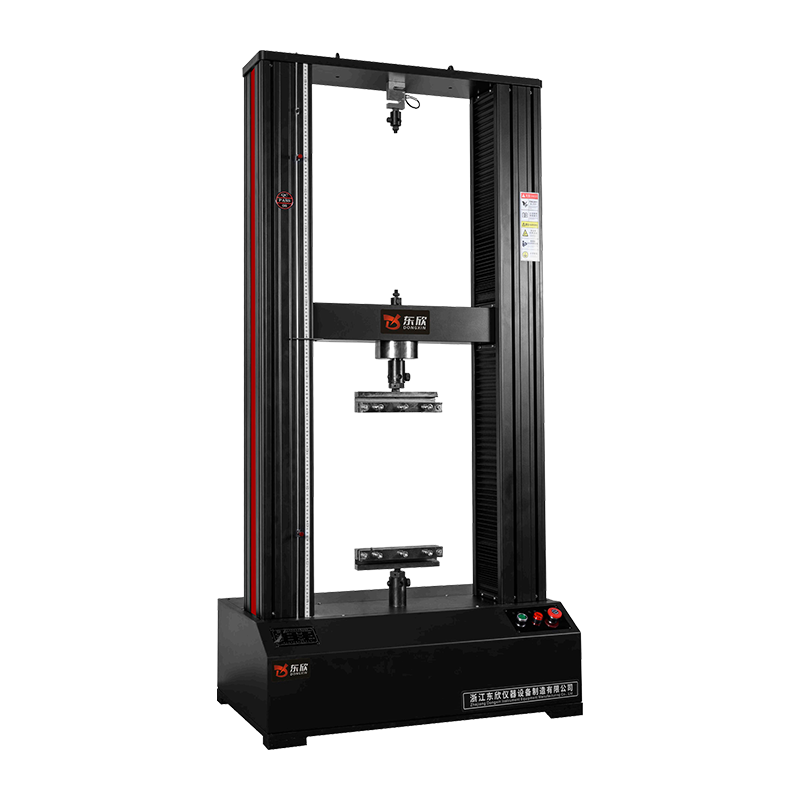 WDW Series Computerized Electronic Universal Testing MachineComputerized universal testing frame that can accept different grips and extensometers; useful for reviewing machine setup and fixture compatibility.View Product →
The WDW series is one example of a computer-controlled tensile frame that can accept different grips and extensometers, but the key is that the whole chain—load cell, strain device, fixture and software—is calibrated and matched to the standard.
Run a static compression test for concrete and brittle materials
Concrete modulus is usually measured in compression, because concrete is rarely used in pure tension. ASTM C469 and EN 12390-13 are common references. The specimen is a cylinder or prism, often capped or ground flat, and a compressometer or extensometer measures axial strain; transverse strain may be measured at the same time for Poisson's ratio.
- Confirm specimen dimensions, maturity, moisture condition and end flatness.
- Centre the specimen on the lower platen and align the compressometer with the load axis.
- Seat the specimen with a low preload, then zero the strain channels.
- Apply load at the specified rate and record stress and strain up to the required fraction of ultimate load.
- Calculate the chord modulus over the defined stress range, and calculate Poisson's ratio from transverse and axial strain.
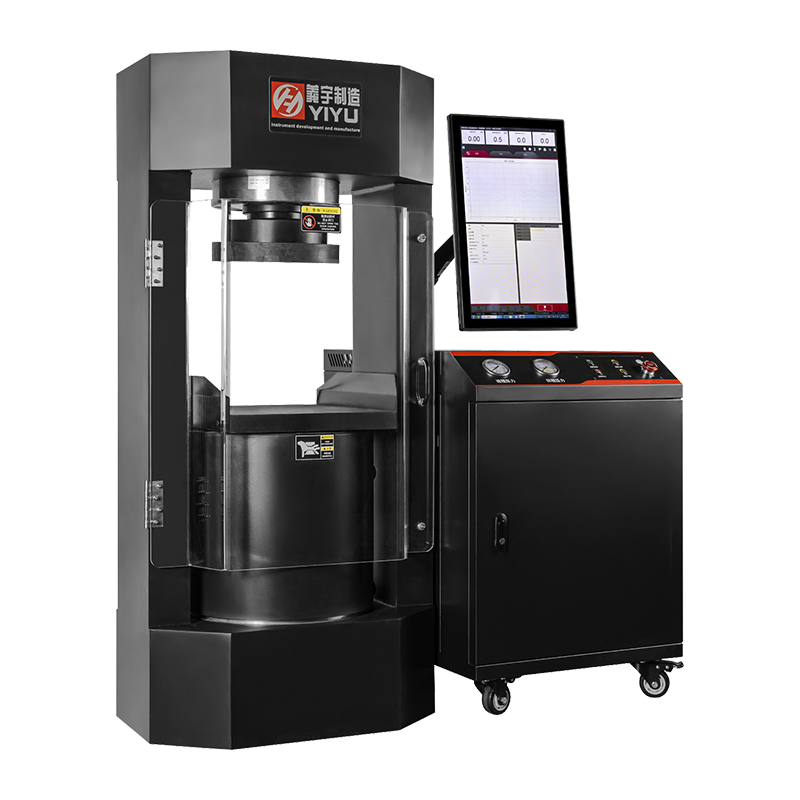
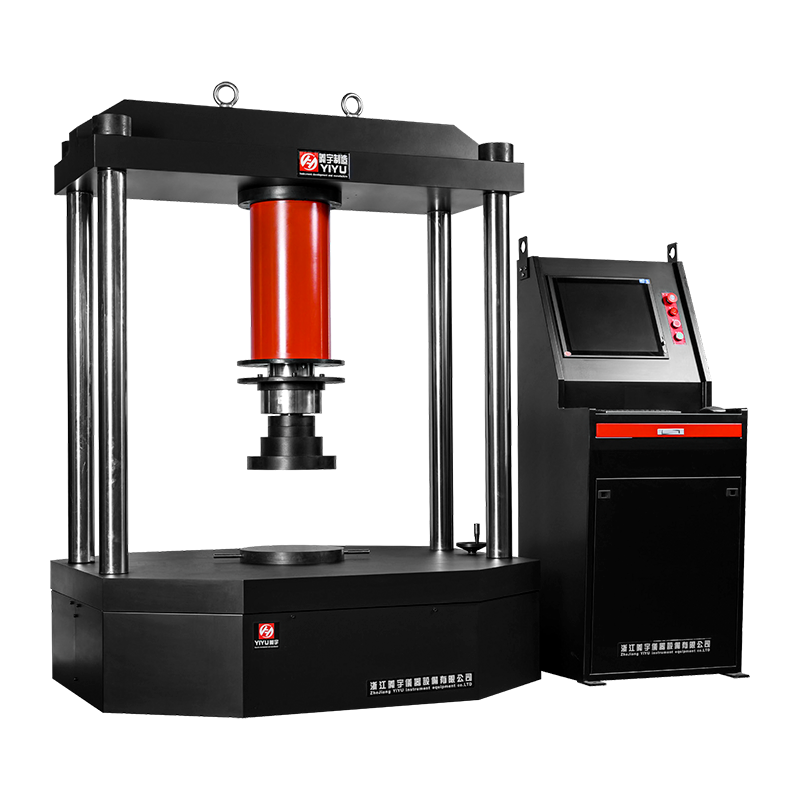
A small eccentricity can bend the cylinder and distort the slope. Rigid platens, spherical seating and a verified compressometer matter more than a large tonnage figure. For controlled compression work, the YAW series is a typical frame type used with the appropriate compression fixtures and deformation instruments.
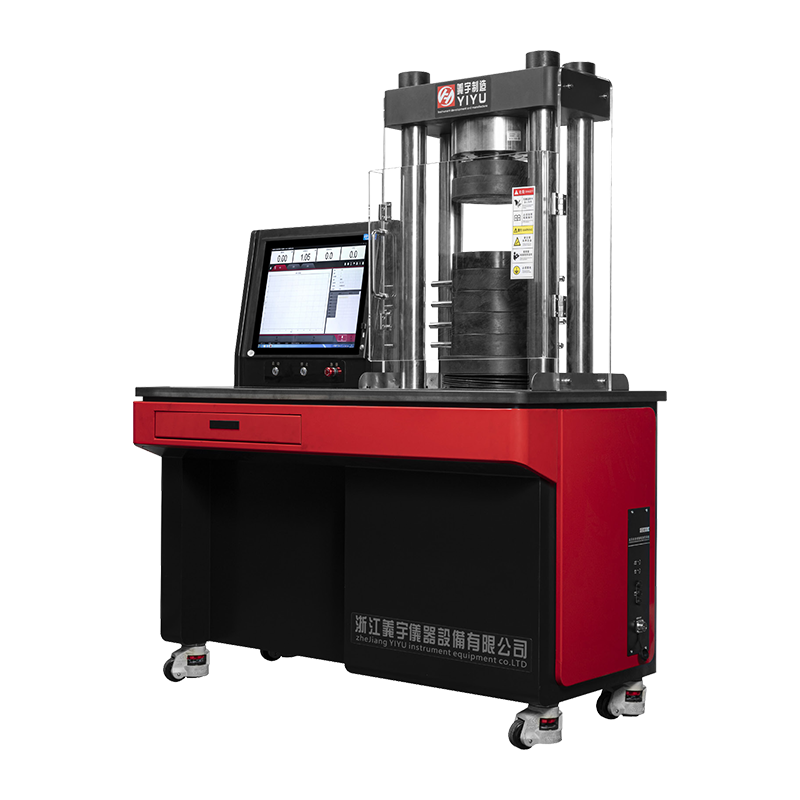 YAW Series Micro Computer Controlled Electro-Hydraulic Servo Pressure Testing MachineElectro-hydraulic compression testing series listed with OEM/ODM support and a PDF download; suits controlled compression work with suitable fixtures and deformation instruments.View Product →
Do not use the compression machine alone as a modulus instrument. The deformation measurement is the part that turns a strength test into a stiffness test.
Use other methods when tension or compression is not practical
Torsion tests produce the shear modulus from the twist of a circular bar or wire. Dynamic methods, such as impulse excitation or ultrasonic pulse velocity, give a dynamic modulus without loading the specimen to failure. These methods are fast and useful for brittle materials, but their values can differ from static modulus because of frequency, microcracking and measurement direction.
Table 1. A practical comparison of common modulus tests; the governing standard always takes precedence over this summary.
| Method |
Typical reference |
What it measures |
Best for |
Watch point |
| Static tension |
ISO 6892-1, ASTM E111 |
Young's modulus in axial tension |
Metals, polymers, composites |
Extensometer slip and grip seating |
| Static compression |
ASTM C469, EN 12390-13 |
Chord modulus and Poisson's ratio |
Concrete, rock, cementitious materials |
Platen alignment and end flatness |
| Torsion |
Applicable torsion standard |
Shear modulus |
Wires, shafts, solid rods |
Twist measurement and clamp slip |
| Dynamic resonance |
ASTM E1876 |
Dynamic Young's or shear modulus |
Ceramics, refractories, small brittle parts |
Specimen geometry and support conditions |
| Ultrasonic |
Applicable wave-speed standard |
Dynamic modulus from wave speed |
Concrete, composites, field screening |
Coupling, path length and density input |
Calculate the slope and report the result honestly
For a uniaxial test, stress is force divided by original cross-sectional area, and strain is change in length divided by original gauge length. Modulus is the slope of the stress-strain curve in the linear elastic region: E = Δσ / Δε. Use regression over a defined range, not two hand-picked points, and record the regression range and correlation.
For concrete, the standard may ask for a chord modulus between a low stress and a specified fraction of ultimate strength. For Poisson's ratio, use ν = -ε_transverse / ε_longitudinal over the same stable range. Report the test standard, specimen orientation, conditioning, strain instrument, loading rate, individual specimen values, mean and range. A single beautiful curve is not a result; repeat tests are.
Avoid the common traps
- Using crosshead travel as strain without compliance correction.
- Leaving slack in the load train, which creates a toe region that gets included in the slope.
- Misaligning a compression specimen or extensometer, producing bending rather than pure axial strain.
- Choosing the linear range by eye after the test instead of defining it before the test.
- Ignoring temperature, moisture and loading rate, especially for polymers and concrete.
- Reporting only the average and hiding the scatter between specimens.
A good habit is to plot every specimen on the same axes before you approve the result. If one curve has a different slope, find out why before averaging. In our experience, most modulus problems are setup problems, not material problems.
Modulus of elasticity testing is not difficult, but it is detail-sensitive. The reliable recipe is simple: select the correct standard and modulus type, prepare and measure the specimen carefully, use a calibrated strain instrument, keep the load train aligned, and calculate the slope over a defined linear range. With that discipline, the number you report will mean something to a designer, a quality engineer or a fellow lab technician. If you are setting up a new test or matching a fixture to an existing frame, you are welcome to talk through your application with our team.

 简体中文
 English
 русский