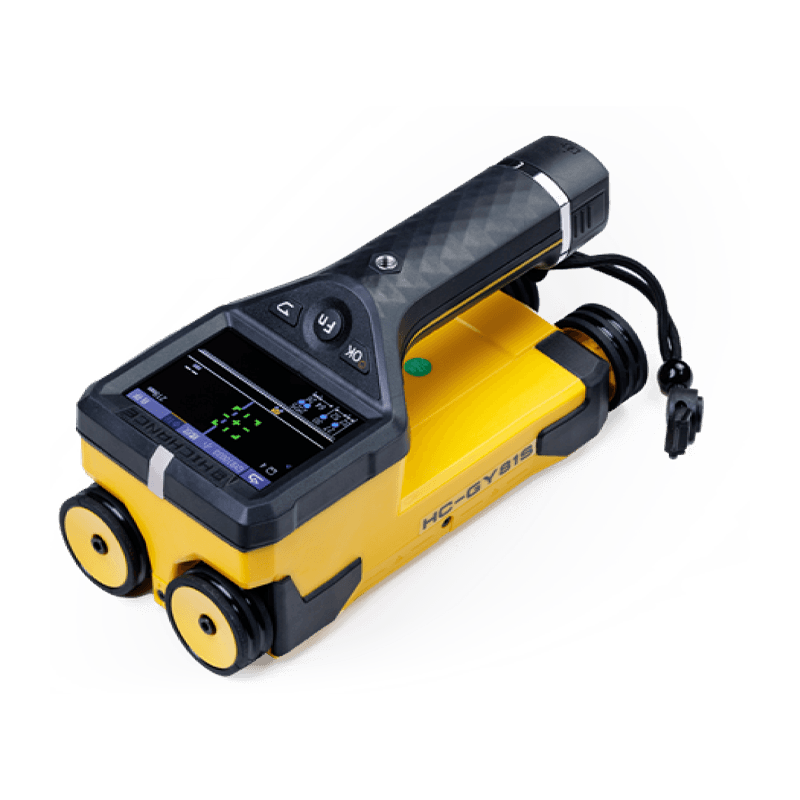
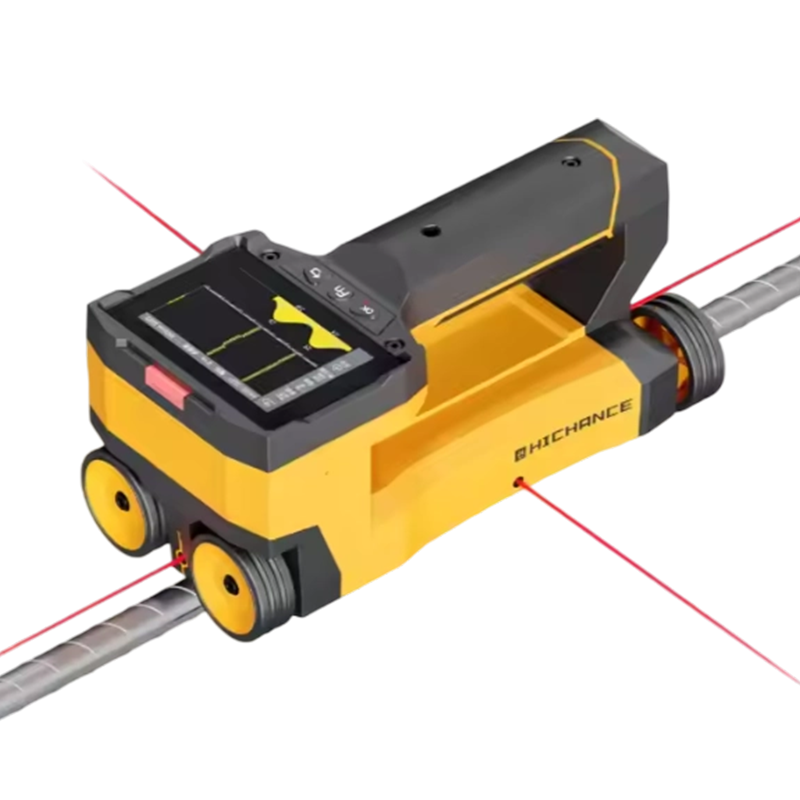
The HC-GY81/GY81S/GY71S/GY62 All-In-One Steel Bar Scanner is a portable, intelligent non-destructive testing device. Featuring an integrated design, this series is specifically engineered to detect the location, concrete cover thickness, orientation, and distribution of rebar within reinforced concrete structures, as well as to estimate rebar diameter. Additionally, it can detect magnetic objects and conductors within non-magnetic and non-conductive media.
Core Design and Functional Highlights
Superior Interaction Design:
- High-Resolution Touchscreen: Equipped with a 3.2-inch (HC-GY81/81S) or 2.8-inch (HC-GY71S/62) high-resolution color LCD screen.
- Dual Operation Modes: Combines a capacitive touchscreen with physical buttons for a more user-friendly interactive experience.
Intelligent Testing Technology:
- High-Precision Detection: Offers cover thickness detection accuracy of up to 0.1mm, supporting dual-channel A/D value indication and automatic center-point reading.
- Smart Calibration: Features a built-in temperature sensor that detects ambient temperature changes and prompts for calibration, ensuring data accuracy.
- Synchronous Display (HC-GY81S only): Equipped with a 1.54-inch secondary screen supporting wireless control and real-time synchronous display, enabling safe and efficient testing without the need for climbing.
Advanced Positioning and Data Transmission:
- Laser-Assisted Positioning: Features 4-way laser indication (vertical laser for HC-GY62) to display rebar location and centerlines in real-time, greatly facilitating drilling and coring operations.
- Real-Time Cloud Connectivity: Includes a built-in 4G module and SIM card (compatible with all major networks) for real-time positioning and direct upload of test data to the server (HC-GY81/81S).
- Bluetooth Connectivity: Built-in low-energy Bluetooth chip allows connection to the Haichuang Data Platform App for real-time data uploading; PC-side Bluetooth reading is also supported, reducing wear on the USB port. ### Key Technical Specifications (HC-GY81/81S)
According to the specifications, the core metrics for the top-tier model in this series are as follows:
Software and Compliance
- Professional Analysis Software: The accompanying software supports data processing, printing, and report exporting, and can generate 3D models.
- JGJ Testing Functions: Complies with relevant testing standards; supports single-point re-testing and automatically generates thumbnails for test points.
- Multi-Mode Adaptability: Supports various specialized modes, including rebar-avoidance detection, reverse-correction detection, and uneven surface detection.
Frequently Asked Questions (FAQ)
Q1: What is the practical use of the "secondary display" on the HC-GY81S?
A: Its 1.54-inch synchronous display is primarily designed for testing at heights or in hazardous locations. Operators can secure the main unit at the test site and remotely view data or control the device via the secondary display, eliminating the need for frequent climbing and enhancing safety.
Q2: How does it perform in environments with densely spaced rebar?
A: The device features an optimized detection algorithm for waveform scanning modes, significantly improving its ability to identify densely spaced rebar and ensuring more accurate concrete cover thickness readings.
Q3: Can I view testing data in real-time on my mobile phone?
A: Yes. By connecting to the mobile app via the built-in Bluetooth 5.2 chip, testing data can be uploaded and displayed synchronously within seconds.
Q4: Is the battery durable? How long does a single charge last?
A: The device utilizes a high-capacity 18650 lithium battery combined with a low-power design. A full charge allows for over 24 hours of continuous operation, sufficient for intensive on-site testing tasks.
Q5: How does the laser indicator assist with positioning?
A: Once activated, the four-way laser projects the precise location of the rebar and the centerlines of adjacent bars onto the structural surface. Before drilling or coring, this effectively prevents accidental rebar cutting, thereby safeguarding the structural integrity of the building.




 简体中文
简体中文
 English
 русский